
Have you ever wondered why some people eat whatever they want and stay lean, while others struggle even with a strict diet? The secret isn’t just “fast metabolism.” It all comes down to one specific number: your Total Daily Energy Expenditure.
Understanding your TDEE Calculator results is the first step toward taking full control of your body. Whether you want to lose stubborn fat, build lean muscle, or simply maintain your current weight, you need a roadmap.
In this guide, we will break down exactly how to calculate your energy needs and, more importantly, how to use those numbers to transform your life.
What Exactly is TDEE?
Before we dive into the numbers, let’s define the term. TDEE stands for Total Daily Energy Expenditure. It represents the total number of calories your body burns in a 24-hour period.
Many people confuse TDEE with BMR (Basal Metabolic Rate). However, while your BMR is what you burn at rest, your TDEE Calculator result includes every movement you make—from brushing your teeth to hitting a heavy deadlift at the gym.
The Four Pillars of Energy Expenditure
To get an accurate TDEE result, the formula looks at four main factors:
Basal Metabolic Rate (BMR): The calories burned to keep your heart beating and lungs breathing.
Thermic Effect of Food (TEF): The energy used to digest the food you eat.
Thermic Effect of Activity (TEA): The calories burned during intentional exercise.
Non-Exercise Activity Thermogenesis (NEAT): Calories burned during daily tasks like walking, fidgeting, or cleaning.
How to Use the TDEE Calculator for Your Goals
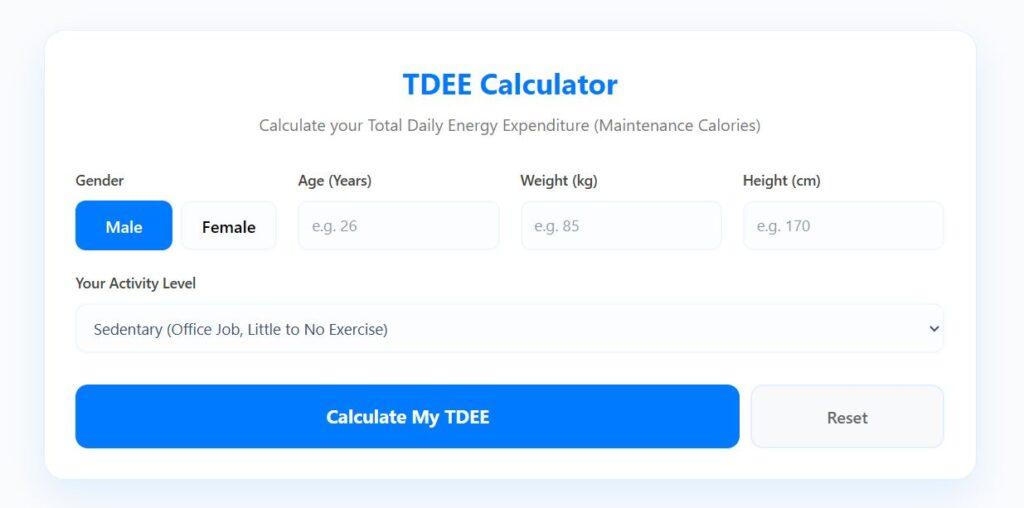
Using a TDEE calculator for weight loss or gain is straightforward, but you must be honest with your data. Most people overestimate how active they truly are, which can lead to stalled progress.
Step 1: Input Your Stats
You will need to provide your age, gender, height, and current weight. These are the baseline metrics that determine your metabolic speed.
Step 2: Choose Your Activity Level
This is where most people make mistakes. If you work a desk job and walk 20 minutes a day, you are likely “Sedentary.” If you hit the gym 4–5 times a week, you might be “Moderately Active.”
Step 3: Analyze the Results
The TDEE Calculator will give you a “Maintenance” number. This is the “sweet spot.” If you eat exactly this many calories, your weight will stay the same.
TDEE Calculator for Weight Loss
If your goal is to shed fat, you need to create a calorie deficit. This means eating fewer calories than your TDEE Calculator suggests for maintenance.
Moreover, a safe deficit is usually around 300 to 500 calories below your maintenance level. For example, if your TDEE is 2,500 calories, eating 2,000 calories will result in steady, sustainable weight loss.
Avoid Extreme Deficits: Eating too little can crash your metabolism.
Prioritize Protein: High protein helps preserve muscle while losing fat.
Track Progress: Use the calculator every 4 weeks as your weight changes.
TDEE Calculator for Muscle Gain
For those looking to get stronger and bigger, you need a “Caloric Surplus.” Using a TDEE calculator for muscle gain helps you find the right amount of extra food to eat without gaining excessive fat.
In addition, a surplus of 200–300 calories is usually enough for body recomposition. This allows you to build muscle slowly while keeping your body fat percentage in check.
The Importance of Body Fat Percentage
Did you know that two people with the same weight can have different TDEE numbers? This is because muscle burns more energy than fat.
A TDEE calculator with body fat percentage is much more accurate. If you know your body fat, you can use the Katch-McArdle formula, which is considered the gold standard for athletes.
Furthermore, if you have a high muscle mass, your maintenance calories will be significantly higher than someone of the same weight with more body fat.
Common Formulas Used in Calculators
Most online tools use one of three main equations to find your energy needs:
| Formula | Best For |
| Mifflin St Jeor Equation | The modern standard for average adults. |
| Katch-McArdle Formula | Best for those who know their body fat percentage. |
| Harris-Benedict | An older formula, still useful for general estimates. |
Why Isn’t My Weight Changing?
If you have been following your TDEE Calculator results but aren’t seeing progress, consider these factors:
Hidden Calories: Oils, sauces, and drinks often go untracked.
Weekend Overeating: One big cheat meal can wipe out a week’s deficit.
Water Retention: High salt or stress can make the scale stay the same even if you are losing fat.
Activity Overestimation: You might be burning fewer calories in the gym than you think.
Related Post
Frequently Asked Questions (FAQs)
1. How often should I recalculate my TDEE?
You should update your TDEE Calculator stats every time you lose or gain 5–10 pounds. As your body weight changes, the energy required to move that body also changes.
2. Can I use a TDEE calculator for teenagers?
Yes, but teenagers generally require more calories for growth. It is always best to consult a doctor before starting a strict calorie deficit at a young age.
3. Is the most accurate TDEE calculator 100% correct?
No calculator is perfect. It provides a highly educated “starting point.” You must track your weight for 2 weeks and adjust your calories based on real-world results.
4. What is the difference between BMR and TDEE?
BMR is the energy your body needs just to survive (coma-state), while TDEE includes all physical movement and digestion throughout the day.
5. Does exercise increase my TDEE?
Yes, Thermic Effect of Activity (TEA) is a major component. Increasing your daily steps or gym intensity will raise your maintenance calories.
Conclusion: Take Action Today
Finding your numbers through a TDEE Calculator is only half the battle. The real results come from consistency and tracking. By understanding your maintenance calories, you stop guessing and start progressing.
Whether you are using a TDEE calculator for breastfeeding moms or aiming for an extreme weight loss goal, keep your approach balanced. Focus on whole foods, stay active, and use these data points as your guide.
Ready to start your journey? Bookmark this tool and calculate your calories today to see the difference!